


Basically it is newer version of IP address. Currently, IPv4 is being used. But it has some limitations. Like...
- Number of available addresses.
Because of increasing number internet users and internet using applications,the number of addresses available is decreasing day by day.
- Security
IPv4 was published in 1981 and current security problems weren't present at that time. So Providing security to IPv4 is very difficult. - Complex address configuration.
Because of increase in number of internet users and internet applications, the address configuration has become complex.
- Quality of Service(QoS). based
Quality of Service (QoS) is available in IPv4 and it relies on the 8 bits of the IPv4 Type of Service (TOS) field and the identification of the payload. IPv4 Type of Service (TOS) field has limited functionality and payload identification (uses a TCP or UDP port) is not possible when the IPv4 packet payload is
encrypted.
These limitations has been over come in IPv6. Key features of IPv6 are as under.
- Number of addresses available.
IPv4 uses 32 bit address. That means it has 232 = 4,294,967,296 available addresses.
Whereas IPv6 uses 128 bit address. That means it has
2128 = 340,282,366,920,938,463,463,374,607,431,768,211,456
available addresses.
- Example of IPv6 address.
IPv4 address:198.10.0.0/16
IPv6 address: 2001:db8:12::/40
- Types of addresses.
Unicast : One to One (Global, Unique Local, Link local)
Anycast : One to Nearest (Allocated from Unicast)
Multicast : One to Many.
- IPv6 Header format is shown below.
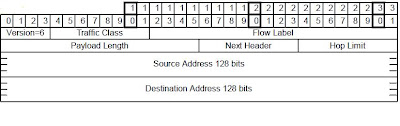
- Decomposition of IPv6 address in to its binary form is shown below.
- 8 June 2011 was named as IPv6 day.


